
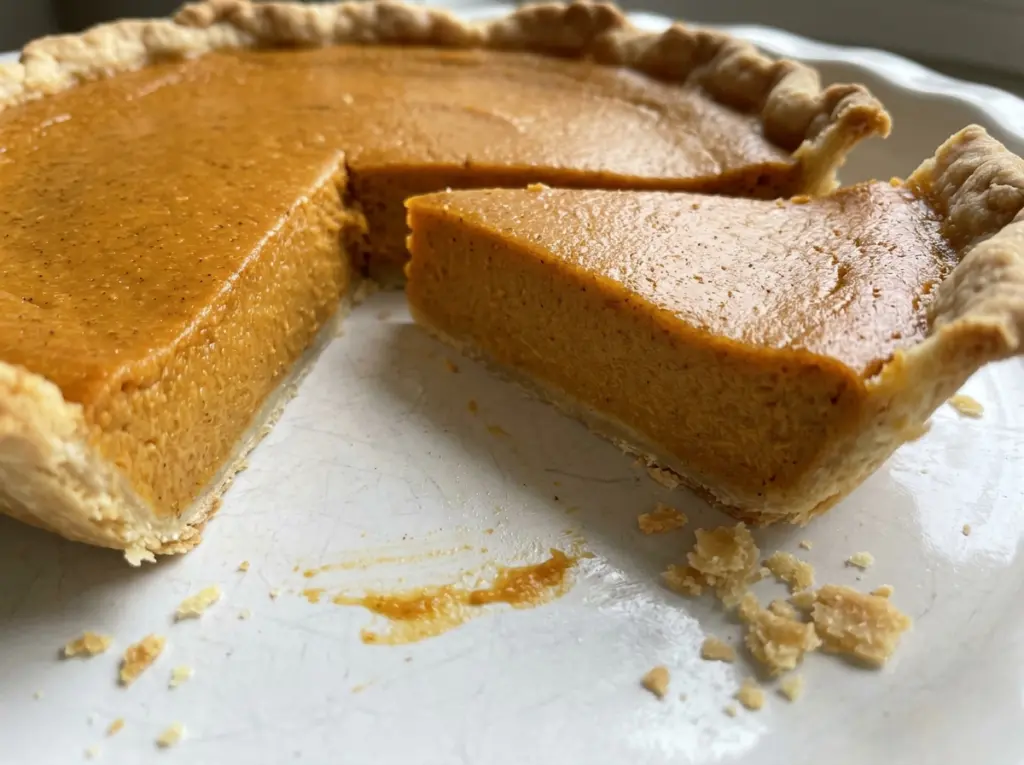
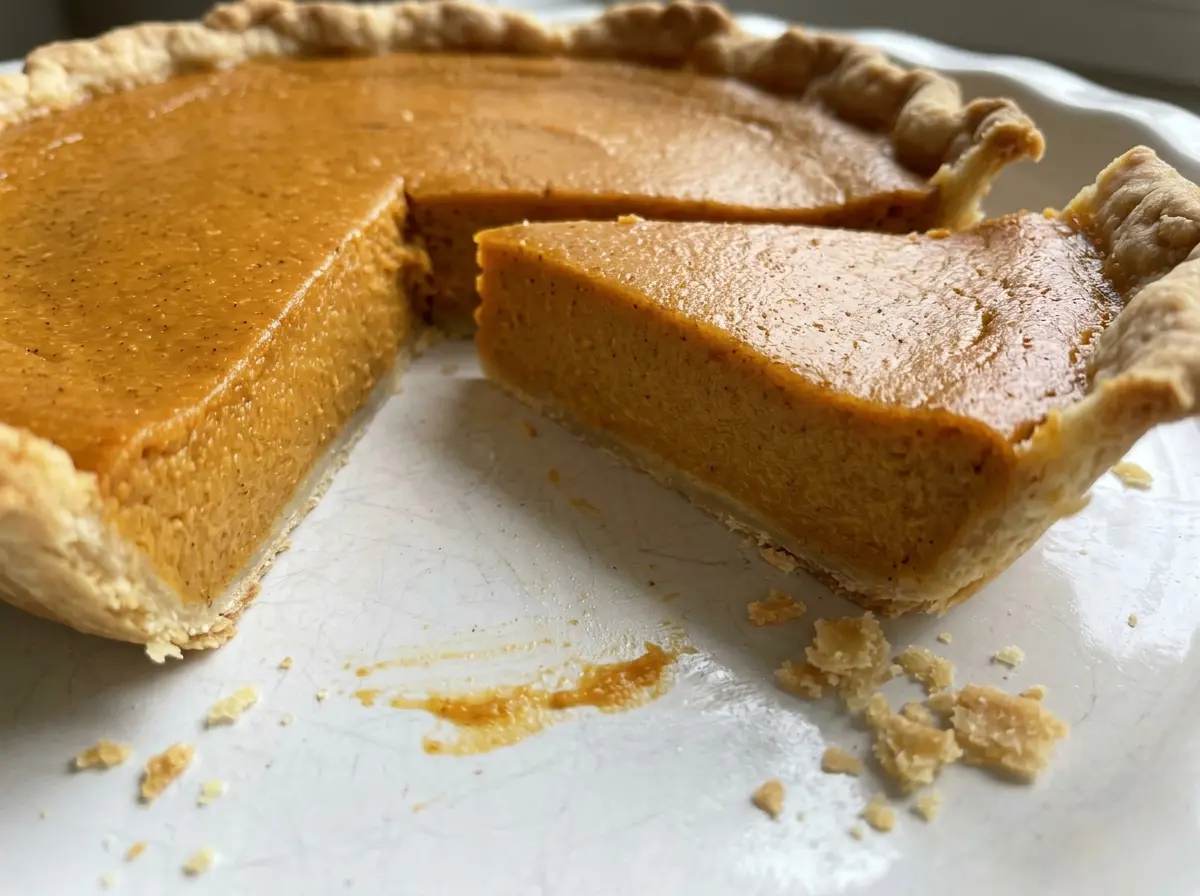
At the end of baking, the outer ring looks set while the middle still gives a small, gentle wobble. That’s the cue I watch for with pumpkin pie: the filling should look settled around the edge, not baked firm all the way across. This pumpkin pie with sweetened condensed milk has a smooth, rich center and a crisp, crimped crust, with cinnamon, ginger, and nutmeg lending warmth without taking over.
Sweetened condensed milk makes the filling straightforward: it brings sweetness and body in the same can, so there’s no separate sugar to measure. I whisk it with plain pumpkin puree, eggs, and the spices until no streaks remain, then bake the pie in two stages. The hot start gives the crust a head start; lowering the oven lets the custard finish more gently. Once cooled, each slice holds its shape but stays soft in the middle.
Kitchen Note
Give the refrigerated crust its full 15 minutes at room temperature before fitting it into the plate. A slightly softened crust bends more easily, so you can crimp the rim without tugging or cracking the dough.
Save this pumpkin pie with sweetened condensed milk for its smooth, warmly spiced filling and simple two-temperature bake.
Why This Pie Starts Hot and Finishes Gently
A pumpkin filling is a custard, not a cake batter, so a single long bake at high heat can set the edges before the center is ready. Starting hot and then lowering the oven gives the crust an initial burst of heat while the filling begins to cook; the gentler finish helps the center set without pushing the outer ring too far. The aim isn’t to bake away every bit of movement. A little wobble in the middle is expected, and the filling continues to firm as the pie cools.
This two-temperature approach also gives you a useful visual check along the way. After the hotter opening portion, the surface should be beginning to set, but the pie still needs its lower-temperature bake. Pulling it as soon as the center is fully firm can leave you with a dry, dense texture. Watching the center’s movement and checking its temperature together makes the finish more reliable than judging color alone.
What the Pumpkin and Condensed Milk Each Bring

- Pumpkin puree — Use plain canned pumpkin puree for a consistent, smooth filling. Store brands work well; the useful distinction is the label, since pumpkin pie filling is already sweetened and spiced. The pie filling mix would change the balance of the condensed milk and seasonings.
- Sweetened condensed milk — This is both the sweetener and a source of richness, giving the filling its characteristic creamy body. A standard can is fine; evaporated milk isn’t a direct stand-in because it isn’t sweetened or as concentrated, so swapping it would change the filling rather than simply replace one product.
- Eggs — Large eggs give the pumpkin mixture the structure it needs to set into slices. Use large eggs rather than smaller ones; there isn’t a straightforward egg-free replacement that will produce the same custard texture with this ingredient balance.
- Ground cinnamon, ginger, and nutmeg — These familiar ground spices are easy to measure and blend evenly into the filling. Fresh, fragrant jars make a noticeable difference in aroma, but there’s no need for specialty brands. Keep the three-spice combination if you want the balanced flavor of the classic pie.
- Refrigerated unbaked pie crust — A ready-made 9-inch crust keeps the preparation focused on the filling. Choose a crust that fits a standard 9-inch pie plate; an oversized or deep-dish shell changes how much filling it can hold. A gluten-free version is an option if it’s made for a 9-inch pie plate.
Fitting, Mixing, and Baking Without Guesswork
Shape the Crust in the Pie Plate
Heat the oven to 425°F while the refrigerated crust stands at room temperature for 15 minutes. Fit it into a 9-inch pie plate and crimp the edge, taking care not to stretch the dough as you shape it. A stretched crust can pull back as it bakes, so settle it into the plate before crimping. Keep the crust unbaked; the filling goes straight into it.
Whisk Until the Filling Is Even
In a medium bowl, whisk the pumpkin puree, sweetened condensed milk, eggs, cinnamon, ginger, nutmeg, and salt together until smooth. Scrape the whisk through the bottom and sides of the bowl so no thick pumpkin streaks or pockets of spice remain. The finished mixture should look uniform, with the spices distributed throughout. Pour it into the prepared crust.
Use the Hot Start, Then Lower the Heat
Bake the pie for 15 minutes at 425°F, then reduce the oven temperature to 350°F and continue baking for 35 to 45 minutes. Look for set edges and a center that still has a slight wobble; the whole surface shouldn’t ripple like liquid when the pie moves. Check the center with an instant-read thermometer and take the pie out when it reads 160°F. Don’t wait for the center to look completely firm in the oven.
Cool Before You Slice
Set the baked pie on a wire rack and leave it to cool for 2 hours before slicing. The filling needs that time to settle into a sliceable custard, so cutting while it’s still warm can leave the center soft and messy. Once you’ve sliced what you’re serving, refrigerate the leftovers. A thin, sharp knife wiped between cuts helps keep the edges tidy.
Small Changes That Still Respect the Custard
Use a Gluten-Free 9-Inch Crust
Replace the refrigerated wheat crust with a gluten-free unbaked crust sized for a 9-inch pie plate. Keep the filling and baking method the same, but handle the shell gently when fitting and crimping because gluten-free crusts can be more delicate. The filling stays smooth and spiced; the crust may be a little more crumbly when served.
Lean Into the Ginger
For a sharper, warmer spice note, increase the ground ginger slightly and reduce the cinnamon slightly, keeping the nutmeg in the blend. The filling’s texture won’t change, but ginger will come through more clearly. Make a modest adjustment so the spice doesn’t overwhelm the pumpkin.
Storage and Reheating
- Refrigerator: Cover the cooled pie or leftover slices and refrigerate for 3 to 4 days. The crust softens gradually as it sits.
- Freezer: Pumpkin custard pie can be frozen, though the filling may be slightly softer after thawing. Wrap fully cooled slices tightly and thaw them in the refrigerator.
- Reheating: This pie is best served chilled or at room temperature, so reheating isn’t needed. Avoid microwaving slices until hot; that can loosen the custard and make it slump.
Questions That Come Up With Pumpkin Pie
Pumpkin Pie with Sweetened Condensed Milk
Ingredients
Equipment
Method
- Heat the oven to 425°F.
- Let the pie crust stand at room temperature for 15 minutes.
- Fit the pie crust into a 9-inch pie plate and crimp the edge.
- In a medium bowl, whisk together the pumpkin puree, sweetened condensed milk, eggs, cinnamon, ginger, nutmeg, and salt until smooth.
- Pour the filling into the crust.
- Bake for 15 minutes at 425°F.
- Reduce the oven to 350°F and bake for 35 to 45 minutes, until the edges are set, the center has a slight wobble, and an instant-read thermometer inserted in the center reads 160°F.
- Cool the pie on a wire rack for 2 hours before slicing.
- Refrigerate leftovers.




