
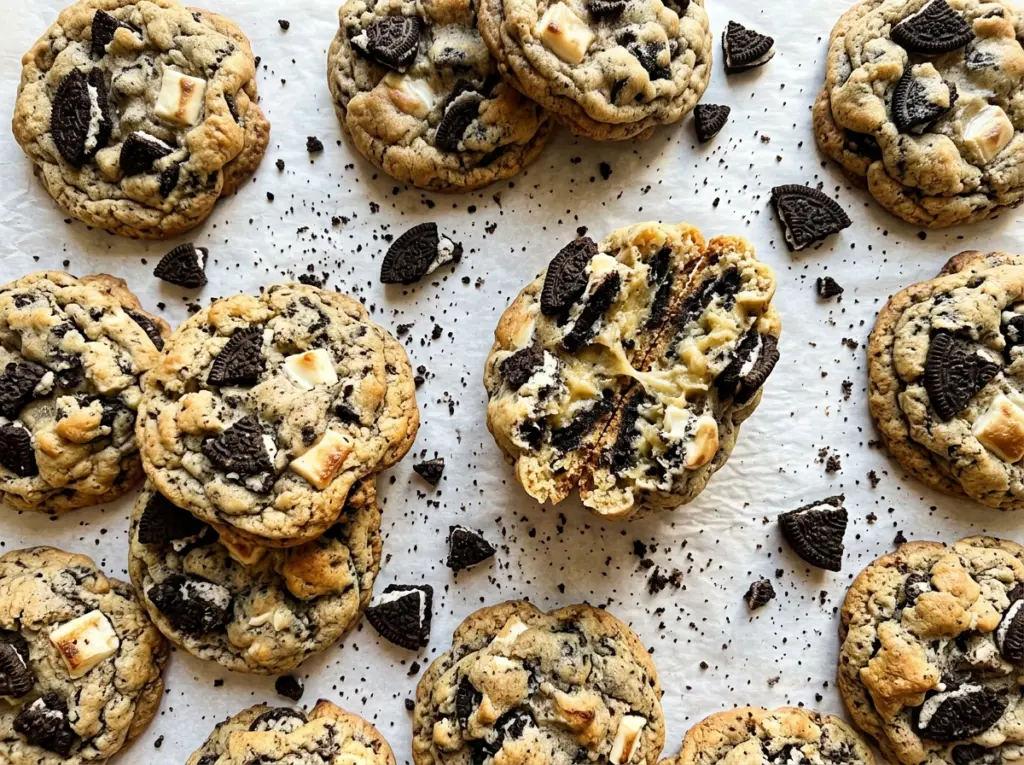
When the chopped chocolate sandwich cookies meet the pale dough, every scoop gets its own pattern of dark cookie pieces and white chocolate chips. I like that no two cookies look quite alike, but the real pleasure is in the bite: a lightly golden edge gives way to a soft center, with bits of sandwich cookie running through it.
These cookies and cream cookies get their tender texture from a dough that’s rich without being heavy. Brown sugar brings a little chew, while the extra egg yolk adds richness; the chopped cookies and white chocolate make each bite feel different from a plain chocolate chip cookie. A short chill helps the dough hold its shape in the oven, so the edges set before the centers lose their softness. The finished cookies are pale and buttery, dotted with dark cookie pieces and creamy chips.

Kitchen Note
The baking sheet needs to be completely cool before the next batch goes on. A warm pan starts softening the dough before it reaches the oven, which can make the cookies spread differently.
Save these Cookies and Cream Cookies for soft centers, golden edges, and a generous scatter of sandwich-cookie pieces and white chocolate.
Why the Dough Needs a Chill Once the Cookie Pieces Go In
Sandwich cookies and white chocolate chips make this dough heavier and chunkier than a plain butter cookie dough. If the butter is still warm from mixing when the tray goes into the oven, the dough can spread before the edges have time to set. Chilling firms the butter back up, giving the cookies a better chance of baking into rounded portions instead of thin, uneven puddles.
That rest also gives the flour time to take up moisture from the egg and butter. The dough feels less loose when you scoop it, and the pieces of cookie stay distributed rather than gathering at the bottom of the bowl. Keep the bowl covered while it chills, and leave the dough you’re not baking in the refrigerator between batches. The goal isn’t a hard dough; it should be cool and scoopable, with the mix-ins held in place.
There’s a useful balance here: the edges need enough time in the oven to turn lightly golden, while the middle should still look a little soft when the pan comes out. The short chill helps that timing work by slowing the early spread, so the centers don’t bake through before the edges take on color.
Which Ingredients Keep the Cookies and Cream Balance

- Butter and the two sugars — Softened unsalted butter creams evenly with the packed brown sugar and granulated sugar. Brown sugar adds moisture and a mild caramel note; granulated sugar helps keep the edges from feeling too soft. Start with butter that yields when pressed but isn’t shiny or melted. If you only have salted butter, omit the added salt so the cookies don’t become overly salty.
- The whole egg and extra yolk — The whole egg helps bind the dough, while the extra yolk contributes richness and a tender, chewy texture. Use a large egg, as specified; a smaller egg changes the amount of moisture in the dough. Room-temperature eggs blend into creamed butter more smoothly, though the dough will still come together if yours are cool.
- All-purpose flour and baking soda — All-purpose flour gives the cookies enough structure to hold the chopped sandwich cookies and chips. Measure it without packing it tightly into the cup; too much flour can leave the dough dry and make the baked centers cakey. Baking soda helps the cookies spread and brown, so don’t swap it for baking powder in the same amount.
- Chocolate sandwich cookies — Coarsely chopped pieces give the cookies their dark flecks and distinct bites. Crushing them into fine crumbs would blend them into the dough rather than leave recognizable pieces. A familiar store-brand chocolate sandwich cookie works just as well as a name brand; use a crisp, classic-style cookie rather than one with a different filling or coating.
- White chocolate chips — Chips hold their shape better than finely chopped white chocolate, leaving creamy pockets in the baked cookies. A chopped white chocolate bar can work, but it may melt into wider streaks. Vanilla extract rounds out the buttery dough; a good-quality extract is nice here, but there’s no need to use an expensive bottle for the flavor to come through.
How to Mix, Chill, and Bake Cookies That Stay Soft in the Middle
Cream the Butter Before Adding the Eggs
Heat the oven to 350°F and line an 18×13-inch baking sheet with parchment paper. Beat the softened butter with both sugars on medium speed for 2 to 3 minutes, until the mixture looks lighter and fluffy rather than dense and greasy. Beat in the egg, egg yolk, and vanilla until smooth, scraping down the bowl so no streaks of butter are left along the sides. If the mixture looks slightly uneven at first, scrape and keep mixing until it comes together.
Fold in the Pieces Without Crushing Them
Add the flour, baking soda, and salt, then mix on low only until the dry streaks disappear. Stop as soon as the flour is incorporated; mixing longer can make cookies tougher. Fold in the coarsely chopped sandwich cookies and white chocolate chips until they’re spread throughout the dough. Use a spatula rather than the mixer for this part so the cookie pieces stay in chunks.
Chill and Portion the Dough
Cover the bowl and refrigerate the dough for 30 minutes. Scoop rounded 2-tablespoon portions onto the prepared sheet, leaving about 2 inches between them so the cookies have room to spread. Keep any dough waiting for the next batch chilled. The portions should be rounded rather than pressed flat; flattening them changes how quickly the centers bake.
Bake Until the Centers Still Look Soft
Bake one batch at a time for 10 to 12 minutes. Look for edges that are set and lightly golden, with centers that still appear slightly soft; waiting for the centers to look fully firm in the oven can leave the cooled cookies dry. Let them sit on the baking sheet for 5 minutes, then move them to a wire rack to cool completely. They’ll be delicate straight from the oven, so give them that short rest before lifting.
Three Changes That Still Let the Sandwich Cookies Shine
Trade the White Chocolate for Semisweet
Use semisweet chocolate chips in place of the white chocolate chips for a less sweet, more cocoa-forward cookie. The dark chips blend in visually with the sandwich-cookie pieces, but the flavor becomes closer to a double-chocolate cookie.
Make a Gluten-Free Batch
Replace the all-purpose flour with a measure-for-measure gluten-free baking blend that includes xanthan gum, and use gluten-free chocolate sandwich cookies. The dough may feel a little more delicate, so keep it chilled and handle the baked cookies gently while they’re warm.
Use Mint Chocolate Sandwich Cookies
Swap the classic chocolate sandwich cookies for mint-filled chocolate sandwich cookies, keeping the same amount and chopping them coarsely. The mint gives the batch a cool, candy-like note that pairs especially well with the white chocolate chips.
Storage and Reheating
- Room temperature: Store completely cooled cookies in an airtight container for up to 4 days. The sandwich-cookie pieces soften as they sit.
- Freezer: Freeze cooled cookies in an airtight container with parchment between layers for up to 2 months. Thaw them at room temperature.
- Reheating: These cookies are good at room temperature. For a warm cookie, microwave one for about 5 seconds and check it; longer heating can make the white chocolate very hot and the cookie overly soft.
Questions That Come Up With Cookies and Cream Cookies
Cookies and Cream Cookies
Ingredients
Equipment
Method
- Preheat the oven to 350°F and line an 18x13-inch baking sheet with parchment paper.
- Beat the butter, brown sugar, and granulated sugar with an electric mixer on medium speed until light and fluffy, 2 to 3 minutes.
- Beat in the egg, egg yolk, and vanilla until smooth, scraping down the bowl as needed.
- Add the flour, baking soda, and salt, and mix on low just until no dry streaks remain.
- Fold in the chopped cookies and white chocolate chips until evenly distributed.
- Cover the dough and refrigerate for 30 minutes.
- Scoop rounded 2-tablespoon portions onto the prepared baking sheet, spacing them about 2 inches apart; keep remaining dough chilled and let the sheet cool completely between batches.
- Bake one batch at a time for 10 to 12 minutes, until the edges are set and lightly golden and the centers still look slightly soft.
- Cool the cookies on the baking sheet for 5 minutes, then transfer them to a wire rack to cool completely.




