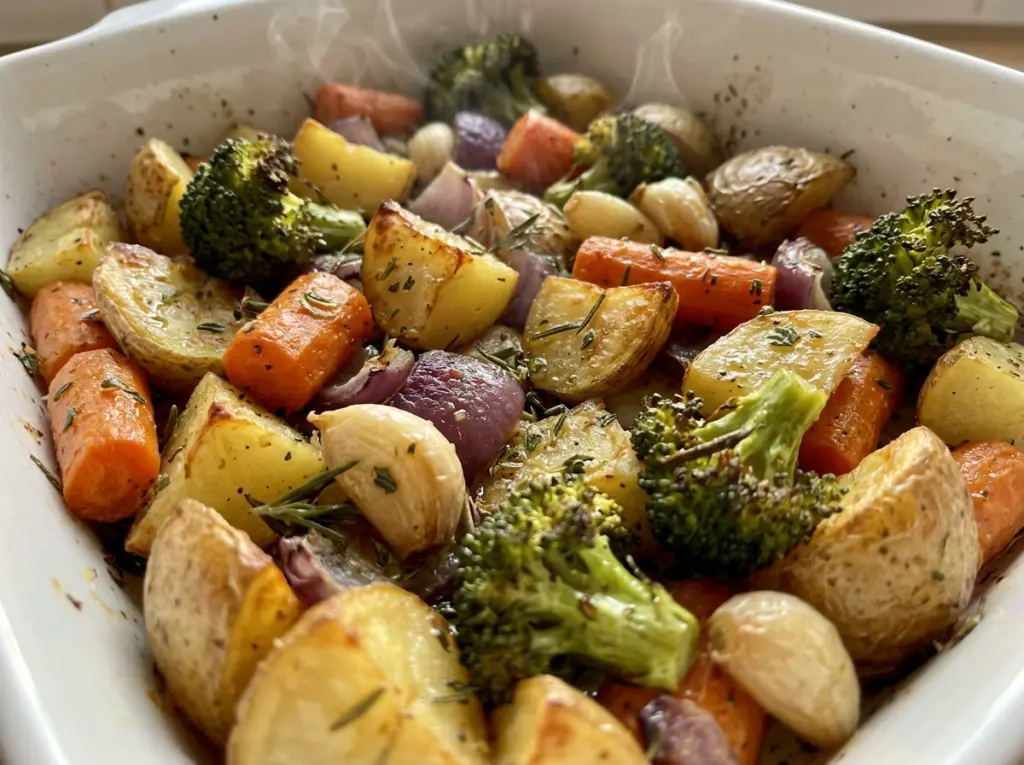
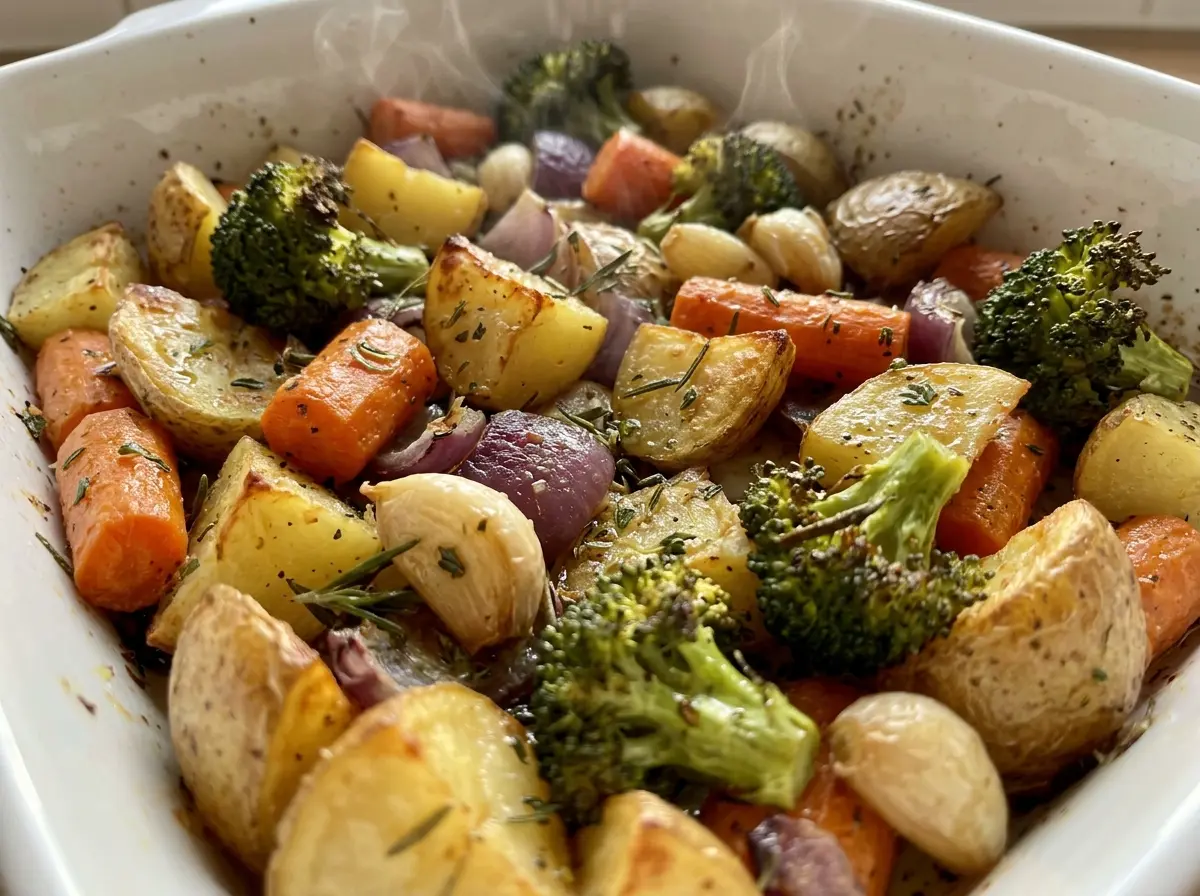
The edges of the potatoes are where this tray gets its best texture: golden and lightly crisp, with soft centers underneath. I cut the vegetables to the sizes listed here and spread them across two pans so they roast instead of crowding together and steaming. The dried herbs cling to the olive oil, and the red onion softens into sweet, browned edges as everything cooks.
These garlic herb roasted potatoes and veggies are built around pieces that cook at different speeds, but the cuts keep each vegetable in a useful range. Yukon gold potatoes stay creamy inside, the thinner carrot pieces turn tender, and the broccoli gets its own shorter stretch in the oven. The finished tray has a mix of browned edges, tender bites, and rosemary and thyme in every forkful.
Kitchen Note
Add the minced garlic only for the final stretch in the oven. Garlic can go from fragrant to bitter if it spends the whole roast exposed to high heat, so toss it through the vegetables near the end.
Save these garlic herb roasted potatoes and veggies for a no-fuss side with golden potatoes, tender carrots, and browned broccoli.
Why the broccoli waits while the potatoes start roasting
Put every vegetable in the oven at once and the broccoli has to stay in long enough for the potatoes to turn tender. By then, its small florets can be dry or overly dark. Staggering the vegetables solves that timing mismatch: the potatoes and carrots get an early start, while the broccoli and onion join later and roast for less time.
The cut sizes matter just as much as the order. A one-inch potato chunk has enough bulk to become creamy without falling apart, while a half-inch carrot piece has more exposed surface and cooks faster. Bite-size broccoli florets brown readily, so they don’t need the same head start. Keep the pieces close to these sizes, and give each pan a single layer with a little space around the vegetables. Crowded pieces trap steam, which softens the edges instead of letting them brown.
Using two rimmed baking sheets also gives the vegetables room without piling them up. Switching the pans between oven racks and rotating them front to back helps account for uneven heat, so neither tray is left with all the pale pieces or all the dark ones.
What each vegetable and herb brings to this roasted tray
- Yukon gold potatoes — Their texture turns creamy while the cut sides brown. Keep the chunks close to one inch so the outsides have time to color before the centers become fork-tender.
- Carrots — Cutting them into half-inch-thick pieces gives them a head start over the broccoli without making them too bulky to soften. Try to keep the pieces a consistent thickness.
- Broccoli florets — Bite-size pieces expose plenty of edges to the hot pan, which is where the browned, slightly crisp texture develops. Very large florets take longer to brown evenly.
- Red onion — Cut it into wedges about the same size as the potatoes. The layers soften and brown at the tips, bringing a mellow sweetness to the tray.
- Olive oil — It coats the vegetables and helps the dried herbs and seasonings cling. Toss thoroughly in the bowl so the vegetables aren’t left with dry patches.
- Dried rosemary and thyme — Dried herbs are convenient here and distribute through the oil easily. Crushing the rosemary lightly between your fingers as it goes into the bowl breaks up any large pieces.
- Fresh garlic — Minced cloves bring a sharper, brighter garlic flavor than garlic that has roasted from the start. Mince it finely so it coats the vegetables when you toss everything together.
This combination is naturally plant-based and contains no gluten-containing ingredients. The vegetables do the work of making the tray filling and colorful, while the herbs keep the seasoning savory without a sauce.
How to roast the vegetables in stages without crowding the pans
Coat the vegetables and set up both pans
Heat the oven to 425°F and line two 18×13-inch rimmed baking sheets with parchment paper. Toss the potatoes, carrots, broccoli, and red onion in a large bowl with the olive oil, rosemary, thyme, salt, and pepper. Transfer just the potatoes and carrots to the pans, leaving the broccoli and onion in the bowl. Spread the first vegetables into a single layer rather than stacking them.
Give the potatoes and carrots their head start
Roast the potatoes and carrots for 20 minutes. Halfway through, switch the pans between racks and rotate them front to back. The pieces should be starting to soften, but they won’t be at the final fork-tender stage yet. Moving the pans helps even out the difference between the upper and lower oven racks.
Add the broccoli and onion for a shorter roast
Divide the broccoli and onion between the two pans, spreading everything out in one layer again. Roast for 12 to 15 minutes, switching the pans between racks and rotating them front to back halfway through. Keep an eye on the thinner broccoli tips; they should begin to brown at the edges, not turn uniformly dark. If vegetables have slipped into a pile, spread them back out so they roast evenly.
Toss in the garlic and finish until tender
Add the minced garlic to the pans and toss the vegetables so it’s distributed throughout. Return the pans to the oven for 5 to 8 minutes. Check a potato with a fork: it should be golden outside and fork-tender in the center, and the carrots should also be tender. The broccoli is ready when its edges are browned.
Two ways to change the vegetable mix without losing the roasted edges
Leave out the red onion
For an onion-free tray, omit the red onion and keep the other vegetables and their staging unchanged. You’ll lose the soft, sweet onion pieces, but the potatoes, carrots, broccoli, rosemary, thyme, and garlic still make a complete savory side.
Make a lower-starch tray without potatoes
Omit the potatoes and use the carrots, broccoli, and red onion for a lighter, lower-starch mix. Keep the oven at 425°F and use the same staggered approach, judging the carrots by tenderness before adding the broccoli and onion; without potatoes, the exact timing won’t be the same. Add the garlic near the end so it doesn’t scorch.
Storage and Reheating
- Refrigerator: Store cooled leftovers in a covered container and eat within 3 to 4 days. The potatoes soften as they sit.
- Freezer: Freezing isn’t ideal; thawed potatoes can turn mealy and the broccoli loses its firm texture.
- Reheating: Spread leftovers on a baking sheet and warm them in the oven until hot. A microwave is convenient, but it softens the browned edges rather than crisping them back up.
Questions that come up when roasting this tray
Garlic Herb Roasted Potatoes and Veggies
Ingredients
Equipment
Method
- Preheat the oven to 425°F.
- Line two 18x13-inch rimmed baking sheets with parchment paper.
- In a large bowl, toss the potatoes, carrots, broccoli, and red onion with the olive oil, rosemary, thyme, salt, and pepper.
- Transfer the potatoes and carrots to the baking sheets, leaving the broccoli and onion in the bowl.
- Spread the potatoes and carrots in a single layer and roast for 20 minutes, switching the pans between racks and rotating them front to back halfway through.
- Divide the broccoli and onion between the pans and spread the vegetables in a single layer.
- Roast for 12 to 15 minutes, switching the pans between racks and rotating them front to back halfway through.
- Add the garlic to the pans and toss the vegetables.
- Roast for 5 to 8 minutes, until the potatoes are golden and fork-tender, the carrots are tender, and the broccoli is browned at the edges.