
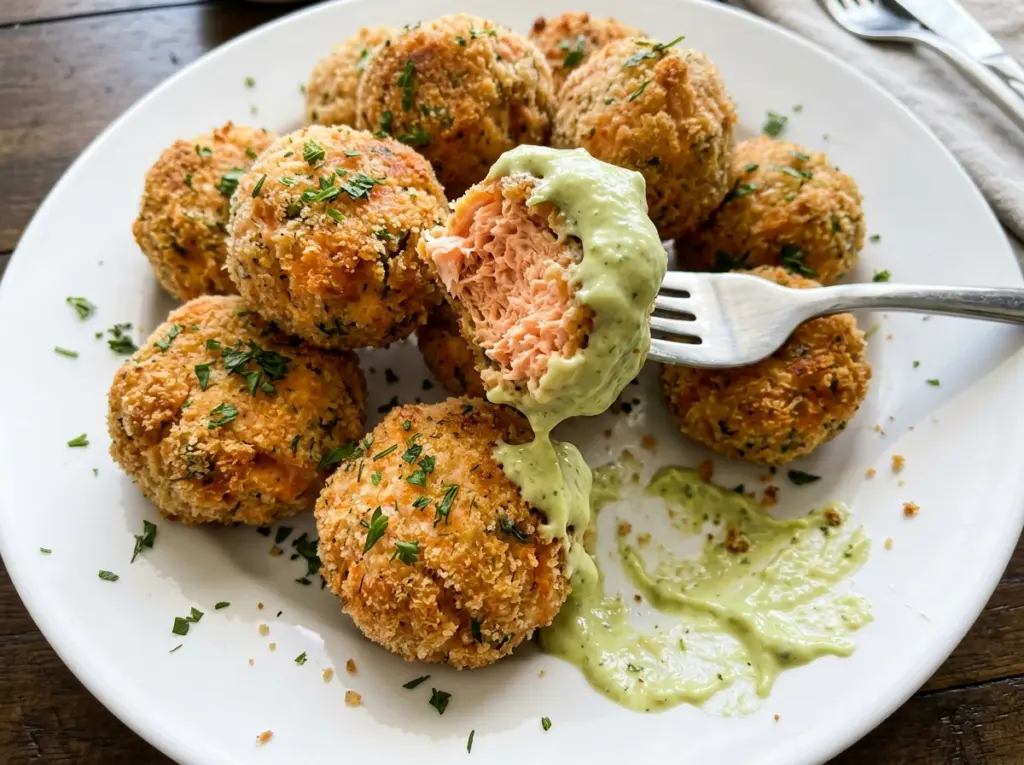
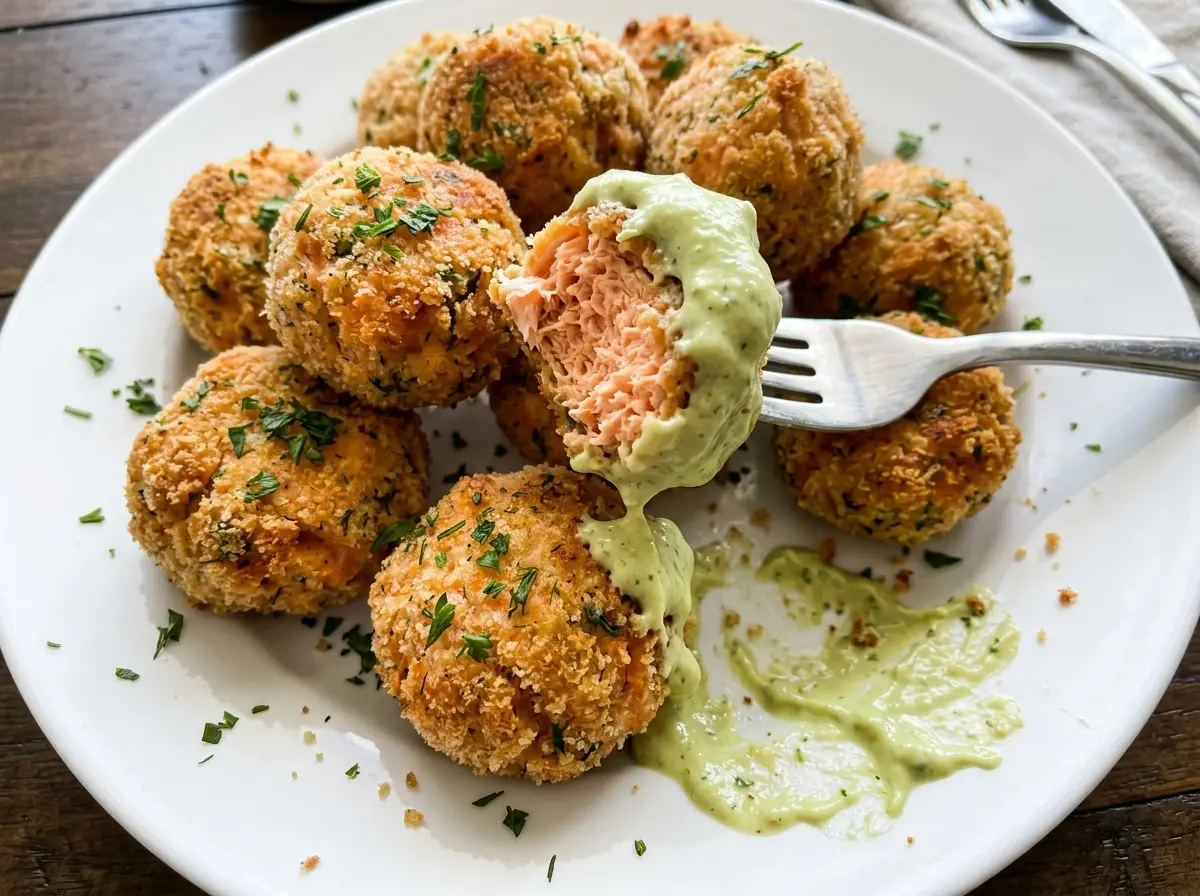
At 425°F, the salmon balls pick up a light golden edge before the inside has time to dry out. I serve these salmon balls with creamy avocado sauce while the sauce is cool and tangy against the warm, tender bites. They make a satisfying main dish without a skillet full of splattering oil, and the parchment-lined baking sheet keeps cleanup simple.
The balance comes from keeping the salmon in the lead: Dijon and lemon sharpen it, while dill adds a fresh note without turning the mixture into a strongly seasoned fish cake. The avocado sauce is blended smooth with Greek yogurt, garlic, and lime, so it’s creamy but still bright. A few minutes of hands-on mixing and shaping are all that stand between you and a platter of golden salmon balls with a cool green dip.
Kitchen Note
Keep the salt divided between the salmon mixture and the avocado sauce. Seasoning both parts gives the finished bite a clearer, more balanced flavor than putting all the salt into one bowl.
Save these salmon balls with creamy avocado sauce for a fresh, oven-baked dinner with tender centers and a cool, tangy dip.
Why These Salmon Balls Need a Light Hand, Not Meatball Treatment
Salmon doesn’t have the same sturdy texture as ground beef, so working the mixture until it’s dense and uniform is more likely to make the finished bites compact than tender. Finely chopped pieces give you a mixture that can hold together without needing to mash it smooth. The egg and panko help bind those pieces, and mayonnaise adds richness to lean fish.
Once the ingredients are evenly distributed, stop mixing. You should still be able to see small bits of salmon rather than a paste. When you shape the portions, use enough pressure for them to hold their round form, but don’t squeeze them tightly. That balance lets the outside brown while the center stays soft. It also makes the balls easier to lift from the parchment after baking.
If the mixture feels a little delicate, take your time shaping each portion rather than stirring in extra crumbs. The panko needs a moment to mingle with the egg and salmon, and a gentle touch preserves the texture you want on the plate.
What Gives the Salmon and Avocado Sauce Their Balance

- Skinless salmon — Choose salmon that smells clean and feels moist, not slippery. Finely chopping it gives the mixture an even texture; fully thawed salmon works too if you drain and pat away surface moisture first.
- Panko, egg, and mayonnaise — Panko keeps the mixture lighter than fine breadcrumbs, while egg holds the chopped fish together. Mayonnaise brings a little richness. Plain Greek yogurt can replace the mayonnaise in the same amount, though the salmon mixture will taste tangier and less rich.
- Dijon, dill, and lemon — Dijon adds a sharp, savory note, and fresh dill keeps the fish tasting bright. Lemon zest carries fragrant citrus oils; lemon juice brings the sharper acidity. If fresh dill isn’t available, use half as much dried dill, knowing the flavor will be less fresh.
- Ripe avocado and Greek yogurt — The avocado gives the sauce its body, and Greek yogurt makes it tangy and easy to blend. Use an avocado that yields slightly when pressed; one that’s hard won’t turn creamy, while an overripe one can taste flat. Sour cream can replace the yogurt in the same amount for a richer sauce.
- Garlic and lime — A small garlic clove adds savory depth without taking over the sauce. Lime juice brightens the avocado and slows browning, though it won’t keep the surface perfectly green indefinitely. Plain water loosens the blend without adding another competing flavor.
From Chopped Salmon to Golden Bites
Mix Until the Ingredients Just Come Together
Heat the oven to 425°F and line a rimmed baking sheet with parchment paper. In a medium bowl, gently combine the finely chopped salmon with the panko, egg, mayonnaise, green onions, Dijon, dill, lemon zest, lemon juice, 1/2 teaspoon of the salt, and black pepper. Stop as soon as everything is evenly distributed; a smooth, mashed mixture is a sign you’ve worked it too much. The mixture should look cohesive but still show pieces of salmon.
Shape Even Portions and Brush with Oil
Shape the salmon mixture into 16 balls, about 1 1/4 inches wide, and arrange them on the lined baking sheet. Keeping the portions close in size helps them cook at the same rate. Set each ball down gently instead of pressing it flat. Brush the tops and sides with the olive oil so they can brown in the oven.
Bake Until Lightly Browned and Cooked Through
Bake for 12 to 15 minutes, until the salmon balls are lightly browned and reach 145°F in the center. Start checking at the shorter end of the range, since individual ovens can vary. A thermometer inserted into the middle of a ball gives the clearest reading. Pull the pan once the centers reach the target rather than leaving the fish in the oven to deepen the color.
Blend the Sauce While the Salmon Bakes
Add the peeled and pitted avocado, Greek yogurt, garlic, lime juice, water, and the remaining 1/4 teaspoon salt to a blender. Blend until the sauce is smooth, stopping to scrape down the sides if ingredients cling above the blades. The finished sauce should be creamy enough to cling to a salmon ball, not watery. Keep it ready while the salmon finishes baking.
Rest Briefly, Then Serve with the Sauce
Let the salmon balls rest for 2 minutes after they come out of the oven. That short pause gives their shape a chance to settle before you move them. Serve them with the creamy avocado sauce alongside for dipping.
Two Easy Ways to Adapt These Salmon Balls
Make the Salmon Balls Gluten-Free
Replace the panko with the same amount of gluten-free panko. It keeps the light, crumbly binder in place, so the mixture still shapes into balls; check that the package is labeled gluten-free if that matters for your needs.
Scale It Down for Two
Cut every ingredient in half and shape 8 balls, keeping them about the same size as the full batch. Bake them using the same temperature and 12-to-15-minute window, checking the center for doneness. The sauce also halves neatly, so you won’t be left with a bowl much larger than the serving.
Storage and Reheating
- Refrigerator: Store the cooked salmon balls and sauce separately in airtight containers for up to 3 days. The sauce may darken slightly on top as the avocado meets air.
- Freezer: The cooked salmon balls freeze well. Cool them, freeze in a single layer, then transfer to a freezer-safe container for up to 2 months; the avocado sauce is best made fresh and doesn’t freeze with the same smooth texture.
- Reheating: Warm the salmon balls in short microwave bursts, turning them between bursts, until the center reaches 165°F. Avoid one long heating cycle, which can dry out the fish.
Questions That Come Up When Making Salmon Balls
Salmon Balls with Creamy Avocado Sauce
Ingredients
Equipment
Method
- Heat the oven to 425°F.
- Line a rimmed baking sheet with parchment paper.
- In a medium bowl, gently mix the salmon, panko, egg, mayonnaise, green onions, Dijon, dill, lemon zest, lemon juice, 1/2 teaspoon of the salt, and black pepper until combined.
- Shape the mixture into 16 balls, about 1 1/4 inches wide.
- Arrange the balls on the baking sheet.
- Brush the balls with the olive oil.
- Bake for 12 to 15 minutes, until the balls are lightly browned and reach 145°F in the center.
- While the salmon balls bake, blend the avocado, Greek yogurt, garlic, lime juice, water, and remaining 1/4 teaspoon salt until smooth.
- Let the salmon balls rest for 2 minutes.
- Serve the salmon balls with the sauce.




